
Your Google ranking is not your AI citation
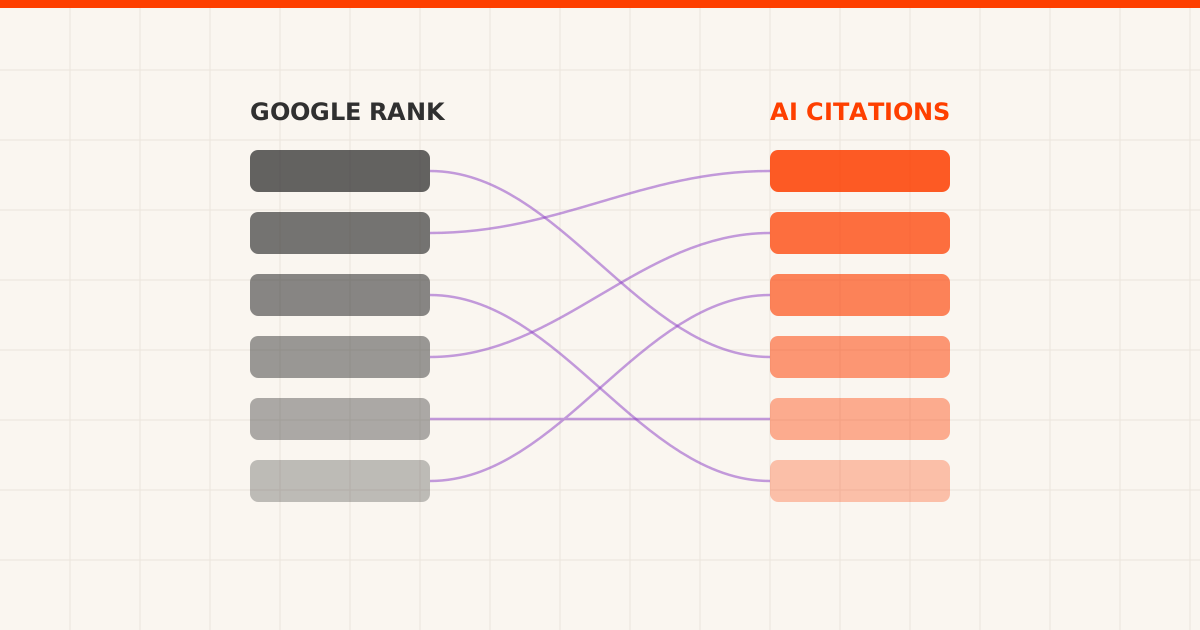
The short version
- Three independent studies all find a large gap between who ranks on Google and who gets cited in AI answers. They disagree substantially on its size.
- Ahrefs put top-10 overlap at 38% of AI Overview citations; BrightEdge, using a different method, put it near 17%. A peer-reviewed measurement found 29.8% of cited domains appear nowhere on page one.
- Overlap on any organic position is meanwhile rising, per BrightEdge. Both things can be true — they measure different questions.
- Practical upshot: your rank tracker is a weak proxy for AI visibility, and treating it as a strong one will mislead you in a specific direction.
Ask a search team whether their brand shows up in AI answers and you will often get a ranking report back. The reasoning is intuitive: we rank first for the things that matter, models read the web, so we must be in the answers.
It is a reasonable assumption and the data does not support it well. It also does not support the opposite slogan — “SEO is dead” — which is being sold just as hard. The honest position sits in an awkward middle, and it is worth sitting there properly.
What three studies found
Notice the spread. Ahrefs and BrightEdge are measuring what sounds like the same thing and differ by more than a factor of two.12 That is not a scandal — they use different keyword sets, different parsers, and different definitions of a “citation” — but it does mean anyone quoting one figure as the number is overstating what is known.
The academic measurement is the most carefully specified of the three. Xu, Iqbal and Montgomery at Washington University in St. Louis collected 55,393 trending queries across 19 categories between March and April 2026, analysed 7,583 AI Overviews, and matched 37,020 of their 61,212 references against 159,752 first-page URLs. Just under 30% of cited domains were absent from page one entirely.3
Why the studies disagree
Different keyword samples (863,000 commercial-leaning keywords versus 55,393 trending queries), different definitions of a citation, different parsers, and different months. AI Overviews also change often enough that a seven-month gap between measurements is a long time. Read these as three readings of the same phenomenon, not three attempts at one number.
The finding that complicates the story
If you stopped there you would conclude that search rankings and AI citations are drifting apart. BrightEdge’s longer series says something different — and it is the more interesting result.
Tracking overlap between AI Overview citations and organic rankings at any position, not just the top 10, they found it rose from 32.3% in May 2024 to 54.5% in September 2025.2
So: AI answers increasingly draw on pages that rank somewhere, while drawing less and less exclusively on pages that rank at the very top. BrightEdge’s own reading is that Google “seeks diversity within ranked content” — its data highlights positions 21 to 100 as the sweet spot for citation growth, rather than restating the first three results.
Ahrefs’ distribution supports that: 31.2% of citations came from positions 11–100, and another 31.0% from beyond position 100.1
Being the biggest brand does not carry over either
There is a related assumption worth testing: that a dominant brand is automatically the cited one.
Semrush tracked more than 50,000 brands across 1,094 US categories monthly from January to June 2026. Only 21% of the most-cited domains in a category were also the most-mentioned brand in that category, and the correlation between citation leadership and mention leadership was slightly negative, at −0.229.4
A negative correlation that small is not a law of nature and should not be reported as one. What it does rule out is the comfortable assumption that category dominance transfers automatically. It does not.
What about position bias?
A popular claim in this space is that models favour whatever appears earliest in their retrieved context, so the game is to be retrieved first.
The controlled evidence is less exciting than the claim. Researchers at Sapienza University of Rome and the Technology Innovation Institute tested this across three QA benchmarks and four models, and found that while positional bias exists in lab conditions, its “impact… is actually marginal in real scenarios since both relevant and distracting passages are, in turn, penalized.” Strategies that reorder passages to exploit positional preference “do not perform better than random shuffling.”5
That is a useful negative result. It means effort is better spent on being retrieved and being quotable than on theories about ordering.
What to do with this
- Stop using rank as a proxy for AI visibility They correlate loosely and the relationship is changing month to month. Measure citations and mentions directly, or you are inferring one unstable thing from another.
- Look at your pages ranking 11–100 Roughly a third of AI Overview citations came from that band. Pages that never justified a ranking push may be the ones already being cited, or one edit away from it.
- Do not decommission your SEO programme Overlap with organic rankings at any position is rising, not falling. Ranking somewhere respectable appears to be close to a precondition; ranking first is not the prize it was.
- Treat single figures with suspicion When two credible studies of the same question differ by a factor of two, the honest summary is a range and a mechanism, not a number.
Questions we get asked
Which of the three overlap numbers should I quote?
If you need one, quote the peer-reviewed one — 29.8% of cited domains absent from page one — because its method and sample are fully specified. Better, quote the range and say the studies disagree. That is the actual state of knowledge.
Does this apply to ChatGPT and Perplexity, or only Google?
The overlap studies here are specifically about Google AI Overviews, because that is the surface where organic rankings and AI citations can be compared side by side. Assistants that do their own retrieval are a different question and are measured separately.
If rank matters less, what replaces it as the KPI?
Citation rate and mention rate on a fixed set of buyer questions, read per model. Rank was always a proxy for "will a buyer encounter us"; that proxy just got weaker, so measure the thing itself.
Is the 76%-to-38% drop a trend I can extrapolate?
No. Two data points from one study are a change, not a trend line. It is a large enough move to act on and far too thin to forecast from.
The honest summary
Every credible measurement finds a substantial gap between ranking and being cited. None of them agrees on how large. The direction of travel is that AI answers draw from a wider slice of the index than the top ten, while still leaning on pages that rank somewhere.
If your AI visibility reporting is currently a rank tracker with a new label on it, that is the thing to fix first.
Sources
- Ahrefs study, reported in Search Engine Journal, "Google AI Overview Citations From Top-Ranking Pages Drop Sharply", 2026. 863,000 keywords, 4 million AI Overview URLs.
- BrightEdge, "Rank overlap after 16 months of AIO", 18 September 2025. BrightEdge Generative Parser, nine industries.
- Xu, Iqbal & Montgomery (Washington University in St. Louis), "Measuring Google AI Overviews: Activation, Source Quality, Claim Fidelity, and Publisher Impact", arXiv 2605.14021, 13 May 2026. 55,393 queries, 7,583 AI Overviews, 61,212 references of which 37,020 were matched against first-page results.
- Semrush, "AI visibility is a topic-level game: A study of 50,000 brands", 20 July 2026. 50,000+ brands, 1,094 US categories, January–June 2026.
- Cuconasu, Filice, Horowitz, Maarek & Silvestri, "Do RAG Systems Really Suffer From Positional Bias?", arXiv 2505.15561, October 2025. Three QA benchmarks, four models.